
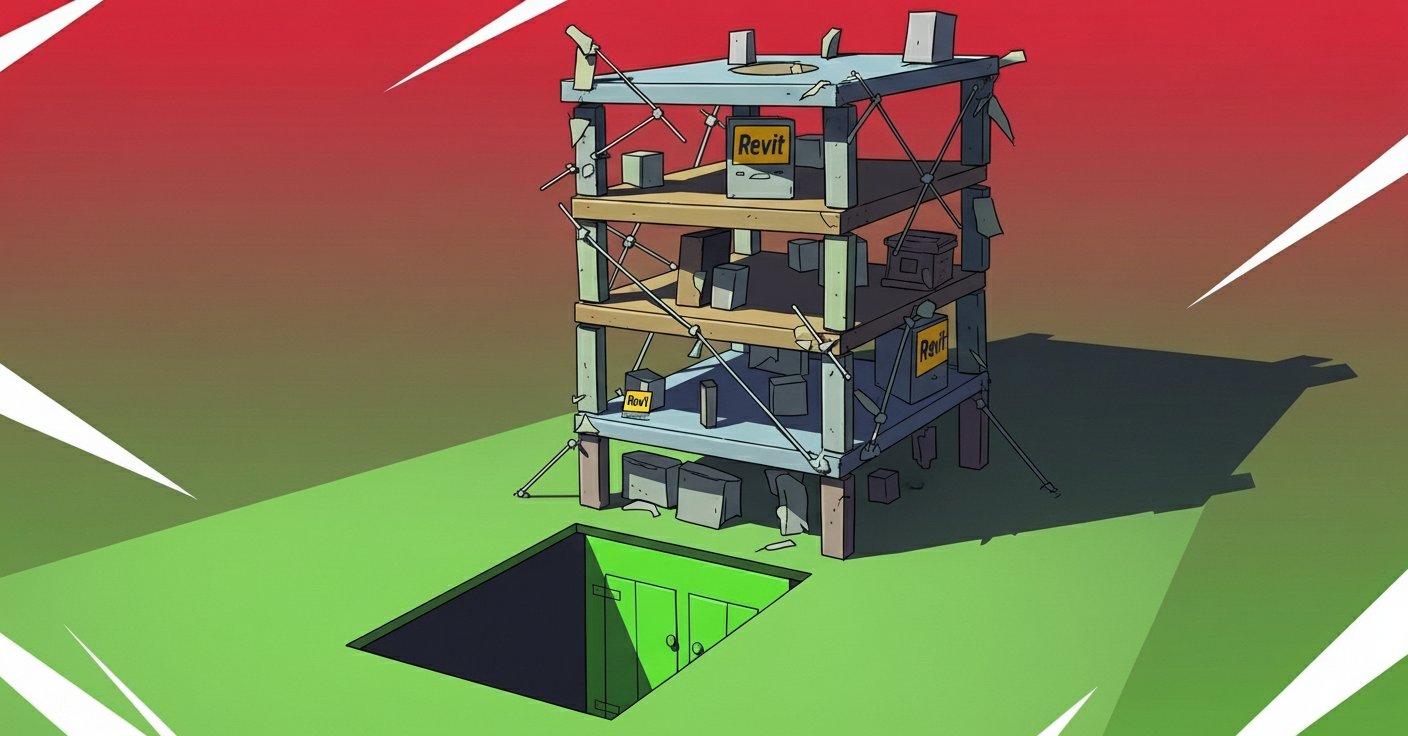
We have been taught to see a building site as a blank slate. A flat, neutral grid waiting for our genius to be imposed upon it. This worldview, rooted in a particular, industrial-era mindset, treats land as a commodity. We arrive with preconceived forms—the glass box, the angular facade—and use our tools to plop them down, fighting the land into submission with retaining walls, massive HVAC systems, and artificial lighting. This approach isn’t just architecturally lazy; it’s psychologically and ecologically impoverished.
This is the core of the “good enough” trap. It’s a failure of imagination and respect, often reinforced by software like Revit, that makes the box the easiest, most efficient option. But true value—for your clients, for the planet, and for your own sense of purpose as a designer—isn’t found in imposition. It’s found in conversation. The most successful, sustainable, and beautiful buildings don’t stand on the land; they emerge from it. This requires a new toolkit, not just of software, but of thought.
The High Cost of the Blank Slate
The trap has a tangible cost. Beyond the environmental toll of energy-inefficient buildings, there’s a professional one. Clients today are increasingly aware of sustainability and wellness. They don’t pay for what’s easy; they pay for what’s valuable. A developer can get a standard glass box from anyone. They hire a design-led firm for a building that responds to its site, creates a unique identity, offers performative advantages, and tells a story.
When your skills stop at basic walls and flat roofs, you become a commodity. You compete on speed and price, not value. But the designer who can deliver a building that feels inherently of its place, that minimizes its energy load through design rather than technology, and that provides measurable wellness benefits? They are solving deeper problems. They command higher fees because they deliver a higher, more meaningful value.
The Psychology of Place: Beyond the Box
This isn’t just about aesthetics or ethics; it’s about human biology. A growing body of research in environmental psychology and neuroscience supports the concept of Biophilia—humans’ innate, genetic affinity for the natural world.
Studies, such as those summarized by organizations like Terrapin Bright Green, have shown that spaces incorporating organic forms, fractal patterns (the repeating, self-similar patterns found in leaves, river deltas, and mountain ranges), and natural materials can significantly reduce stress, lower blood pressure, improve cognitive function, and enhance creativity. Our brains are not designed for the sensory poverty of flat, repetitive geometry. They are calibrated over millennia to respond positively to the visual and tactile complexity of nature.
The default box ignores how light diffuses softly through a canopy, how sound travels across a meadow, or how shelter feels when it’s formed by a grove of trees. We end up fighting these innate preferences with excessive artificial lighting, acoustic panels, and rigid circulation paths—all costly corrections for a poorly designed environment.
The New Toolkit: A Process of Listening and Translation
Before you open any software, your first and most important tools are your senses and your curiosity. The site is not empty. It is a living archive of ancestral intelligence, ecological wisdom, and cultural memory. Your job is to learn its language.
- Read the Land (The Ecological Brief): This is active observation. What are the sun and wind patterns through the seasons? Where does the water flow and collect? What native plants thrive here, and what does that tell you about the soil, climate, and ecosystem? This isn’t just data for a sustainability checklist; it’s the fundamental design brief written by nature itself. A slope suggests a terraced design. A prevailing wind demands a specific orientation or a wind-breaking form.
- Listen to the Culture (The Ancoral Intelligence): What has worked here for centuries or even millennia? This is not about creating a pastiche of “rustic” architecture. It’s about understanding the “why” behind the vernacular. A courtyard house in a hot, arid climate isn’t just a style; it’s a brilliant machine for creating a cool, protected microclimate. The long, steep roofs of Alpine chalets aren’t just quaint; they are engineered to shed heavy snow loads. The elevated stilt houses in tropical regions manage flooding, promote cooling ventilation, and respect the natural pathways of animals. This is Ancestral Intelligence (AI)—the original, time-tested form of performance design.
- Identify the Patterns (Form-Finding): The goal is to find the forms and patterns that are already working. Is the wisdom of this place found in the sprawling canopy of a native oak? In the aerodynamic shape of a grass that bends in the wind? In the structural efficiency of a spider’s web? Your design should not ignore these patterns; it should continue them. This is where you move from analysis to inspiration.
Form Follows Conversation, Not Just Function
The old modernist mantra “form follows function” is incomplete and has been used to justify isolated, internalized thinking. The new mantra is form follows conversation. In other words, a continuous and responsive dialogue between human needs and the environmental context.
Your initial massing shouldn’t be a guess. It should be a hypothesis based on your observation.
- Does the site demand a building that hugs the ground to avoid harsh winds? Or one on stilts to respect flood plains and allow fauna to pass beneath?
- Should the roof be steep to shed heavy rain or snow, or broad and overlapping to provide deep shade from a high sun?
- Does the social structure of the community suggest a centralized gathering space or a series of smaller, interconnected units?
This is where Rhino and Grasshopper become your ideal partners for the ideation phase. Their fluid, iterative nature allows you to quickly sketch in 3D, generating dozens of massing studies that respond to these questions. You can use Grasshopper to model the sun’s path and literally sculpt a form to maximize winter light and minimize summer heat. You can analyze wind flow and carve openings to promote natural ventilation. This is the stage of configuring and manipulating forms until they respectfully reflect the environment you’ve studied.
Validation, Not Just Documentation: Revit’s Higher Purpose
Once the conceptual form is discovered through this iterative dialogue, you bring it into Revit. But now, Revit’s role transforms. It is no longer just a documentation tool. It becomes your validation engine.
You bring your Rhino-generated mass into Revit (via Rhino.Inside or import), not to merely detail it, but to interrogate it within a rigorous BIM environment.
- Does it really work? Use Autodesk Forma’s powerful cloud-based analysis to study sun, wind, energy, and microclimate impacts on your early-stage Revit massing. Forma allows you to run these simulations quickly and iteratively, providing data to inform your design decisions before you’ve even drawn a wall.
- Can it be built? This is where Revit’s integrated systems shine. Use Revit’s own structural analysis tools or its seamless connection to Autodesk Robot Structural Analysis to understand the load paths of your organic form. These tools can validate the structural integrity of complex curves and unconventional shapes, ensuring your beautiful design is also buildable and safe. Can local materials be used in this structure?
- What is its true performance? Dive deeper into energy modeling with insight from Forma or by using Revit’s detailed model for more advanced analysis. Does the form perform as well as you hoped? Use the data to tweak the massing back in Rhino, continuing the conversation between creative exploration and analytical validation.
This back-and-forth collaboration between Rhino’s generative freedom and the analytical power of the Revit-Forma-Structural Analysis ecosystem is an interplay that should be at the core of any contemporary project. The final Revit model will not be a static set of drawings but an evolving record of a deeply informed, responsive process.
The Call to Action: From Creator to Curator
This philosophy demands a significant shift in how we see ourselves. The approach requires a humbler, more thoughtful view of our role. We are not just creators of new objects; we are curators of place. Our value is no longer in our ability to draw quickly, but in our capacity to listen deeply, synthesize complex information from ecology, history, and human psychology, and translate it into a built form that feels both inevitable and inspiring.
This is how you escape the “good enough” trap. You stop selling hours of drafting and start offering wisdom. You deliver buildings that are cheaper to operate, healthier to inhabit, and deeply connected to their place—a value proposition any client will pay a premium for.
The tools are ready. The land is speaking. It has been for millennia. The only question is, are you ready to listen? Start a conversation with Revitrealm.
Share the new knowledge with someone.
- AI Won’t Steal Your Job—But a Designer Using These Tools Will Have a Major Advantage
 AI won’t replace architects—but designers who master Grasshopper, Dynamo, Rhino.Inside, and generative AI will. Here’s how to gain the advantage before they do.
 - The ‘Good Enough’ Trap: How Mediocre Revit Skills Cost You FeesBasic Revit skills keep you stuck in commodity work. Learn how “good enough” habits cost architects fees, and how deeper parametric and site-responsive design wins clients.
- Adaptive Components Demystified: Revit’s Secret Weapon for Complex GeometryStruggling with complex forms in Revit? Adaptive components are the secret to intelligent panels, twisting canopies, and responsive façades. Here’s how they work.